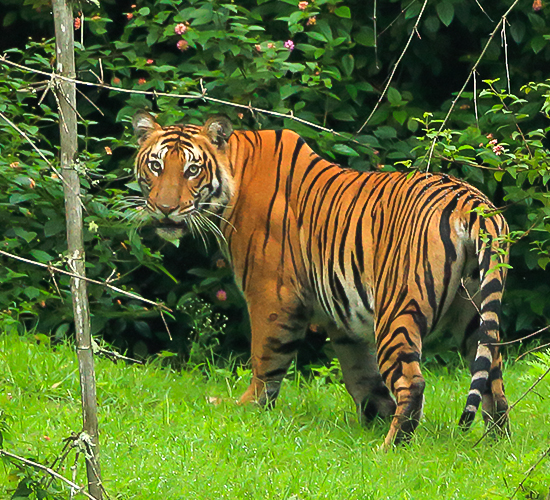
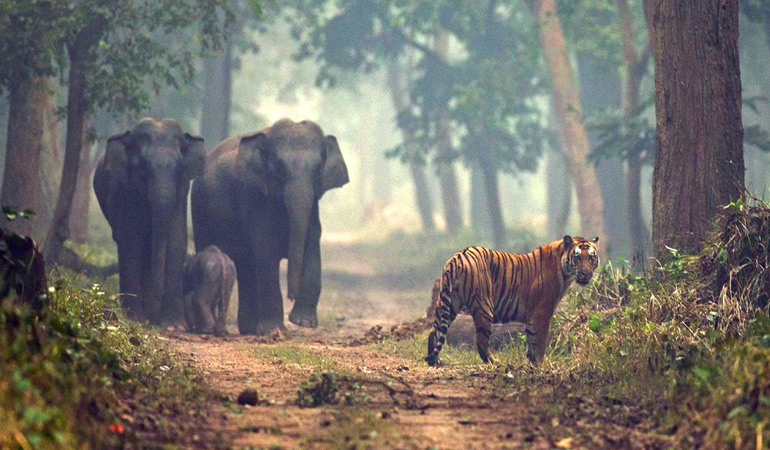
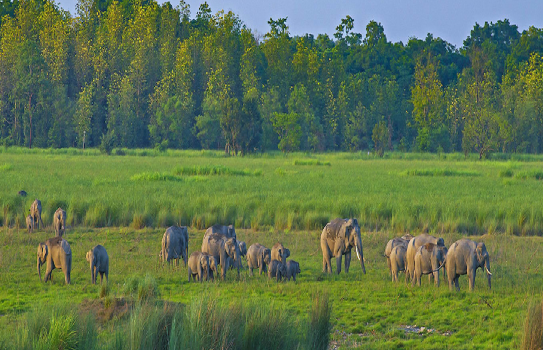
In the Terai region of Uttar Pradesh, India, lies the protected area known as Dudhwa National Park. With a land area of 490.3 square kilometres, the park is well-known for its wide variety of plants and animals.Dudhwa National Park’s history began in 1958 when the Uttar Pradesh forest department created a small wildlife sanctuary in the area. The Wildlife Protection Act of 1972 led to the sanctuary’s expansion and its designation as a national park in 1977.Numerous animal species, such as tigers, leopards, rhinoceroses, elephants, swamp deer, and many more, can be found in the park. With over 450 bird species identified, it boasts a diverse avifauna as well. Notable species include the Sarus Crane, Great Slaty Woodpecker, and Bengal Florican.The park has encountered a number of difficulties.
Discover Dudhwa National Park
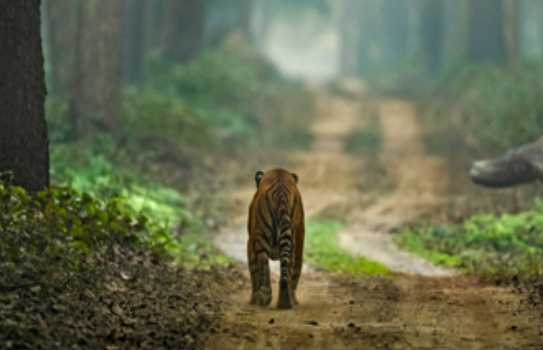
Dudhwa National Park
over time, such as habitat loss, encroachment, and poaching. As a result, the government has established anti-poaching units, moved villages inside the park’s borders, and launched community-based conservation initiatives, among other steps, to safeguard the park.Dudhwa National Park is a well-liked travel destination for tourists and animal lovers and is now regarded as one of India’s most significant conservation areas. The park is still a key location for studies and conservation initiatives, and it is the site of numerous ongoing initiatives meant to preserve its abundant biodiversity.
History of Dudhwa National Park
An example of a typical terai eco system representative is Dudhwa Tiger Reserve. The Indian section of the terai arc landscape spans five states along the Shivaliks and Gangetic plains, from the Yamuna River in the west to the Valmiki Tiger Reserve in Bihar in the east.
This unusual landscape is divided into two distinct zones: (i) Bhabar, which is hilly and features boulders, coarse alluvium, mixed and miscellaneous vegetation communities, and (ii) Terai, which is clay-rich and features fine alluvium, with tall grasslands and sal forest predominating. The terai, in particular, is recognised as one of the 200 most significant ecoregions in the world because of its distinct large mammal assemblage. As a result of the decades-long battle against malaria, the creation of multiple settlements, and
due to the post-independence era’s subsequent rise in human population, this landscape has severely fragmented and deteriorated. Due to this, species like the northern swamp deer (Cervus duvauceli duvauceli) and one-horned rhinoceros (Rhinoceros unicornis) have become extinct in the area, though recent efforts to increase their numbers have begun.
The main protected area complex in the terai, with one of its components having the status of a national park, is the Dudhwa Tiger Reserve, which is made up of three protected areas: the Dudhwa National Park, the Kishanpur Wildlife Sanctuary, and the Katarinaghat Wildlife Sanctuary.
The Upper Gangetic Plains (7a) Biogeographic Province’s Terai-bhabar Biogeographic Subdivision is only represented by Dudhwa National Park and Tiger Reserve. The area’s vegetation is
kind of Moist Deciduous North Indian tree. Some of the best sal forests in the nation can be found there. There is a great variety of plants and plant communities present, according to current documentation. A number of these are important for conservation.